
Do you need a permit for a porta potty in Montgomery?
Most residential jobs don't need one. If your porta potty rental sits in a driveway, backyard, or job site pad, you're on private ground and permitting rarely applies. The picture changes once a unit has to sit in the street, on a sidewalk, or in a public easement, which is common for downtown renovation work or events near closed lanes. Montgomery Porta Pros checks placement with you before scheduling, because right-of-way rules are handled city by city and we treat that as NOT VERIFIED until confirmed. This isn't unique to Montgomery. A dumpster permit or a temporary power pole permit follows the same private-versus-public logic in most cities, whether you're asking about a Jersey City dumpster permit or a Delaware porta potty rental. If your project also needs a roll-off dumpster rental or a temporary power pole, each one gets checked separately, since a dumpster permit and a toilet placement aren't governed by the same rule even on the same job site. For homeowners doing a kitchen gut or a roof tear-off, see our home renovation porta potty guide before you assume no permit is needed.
Where can a porta potty be placed on my property?
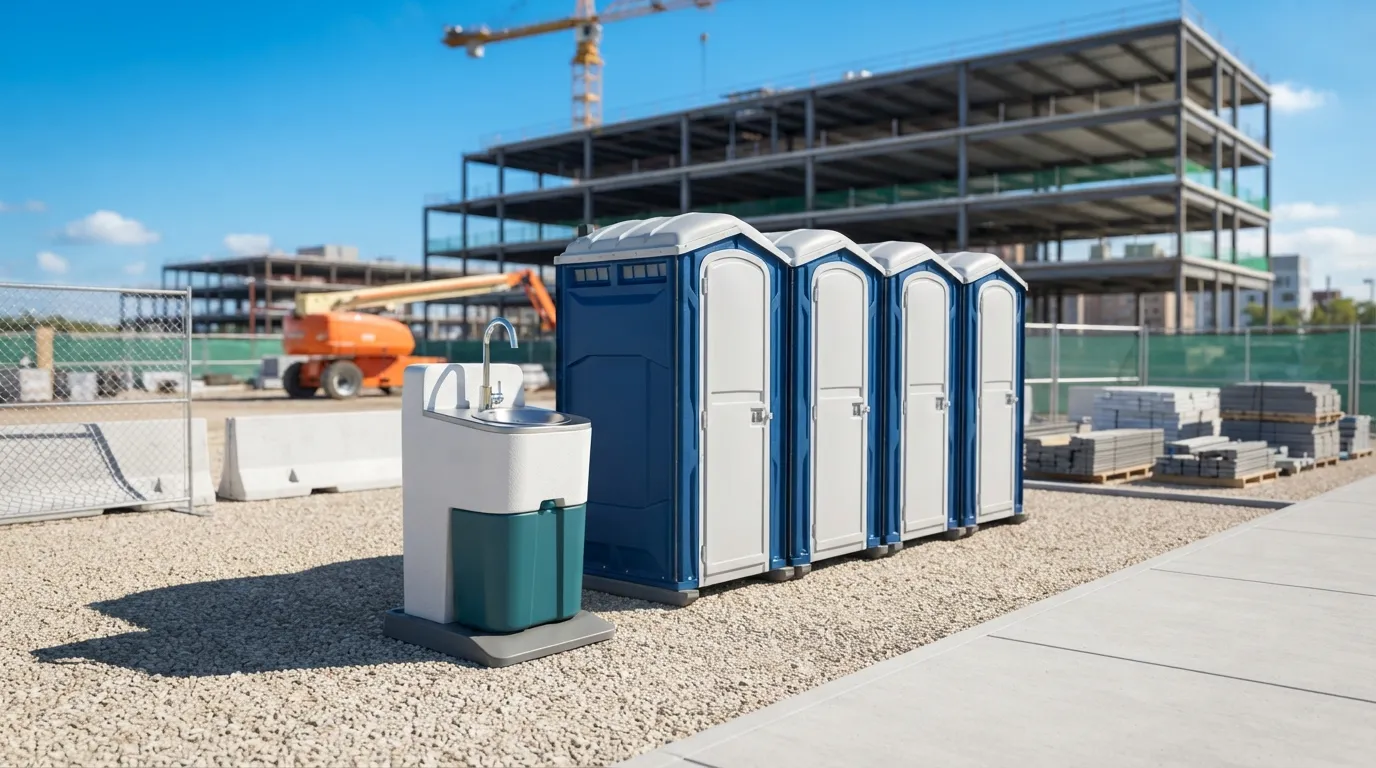
Placement rules protect access more than they protect appearance. Keep a unit reachable for our service truck, keep it off soft ground that will rut, and keep the door swing clear. If you're setting up for a crew, OSHA 1926.51(c)(1) sets the ratio that drives how many units you need: one toilet for 20 workers or fewer, moving up from there as headcount grows, which our how many porta potties do I need page breaks down by crew size. Accessible placement matters too. ADA Standards section 213.2 requires that at least 5 percent of a cluster of single-user units be accessible, never fewer than one, and our ADA accessible porta potty page covers what that unit needs on the ground, including the 60 inch turning circle called out in ADA Standards section 304.3.1. Full porta potty placement rules cover clearance, slope, and tie-down details for Montgomery weather. For events, check event restroom rental or festival restroom rental for layout guidance specific to crowds.
What permits apply to dumpsters and other equipment in Montgomery?
Dumpster permitting follows the same private-property-first rule as porta potties. A roll-off sitting in your own driveway or lot typically needs nothing from the city, but curbside placement is the trigger that usually requires a look, and it's NOT VERIFIED without a call to Montgomery's permitting office. See dumpster permit requirements for the full breakdown, and dumpster sizes and dimensions if you're not sure a 10 yard, 20 yard, 30 yard, or 40 yard dumpster rental fits your driveway. A roll-off delivery truck needs about 60 feet of straight clearance behind the drop point, which matters as much on a tight Montgomery lot as it does on a wide commercial pad. Know what's excluded too. Check what cannot go in a dumpster and dumpster weight limits before loading, since overloads and banned materials cause more permit-adjacent headaches than placement ever does. Temporary fencing sometimes gets pulled into the same conversation; a temporary fence rental or chain link temporary fence around a dumpster or restroom cluster is a site-safety choice, not usually a permitted structure, but confirm locally if it touches a sidewalk.
What OSHA and ADA rules apply even without a city permit?
Permits and federal workplace rules are two different things, and skipping the permit question doesn't skip the second one. OSHA 1926.51(c)(1) sets toilet-to-worker ratios on construction sites, and OSHA 1926.51(a)(1) requires an adequate supply of potable water at the same site. If your crew is spraying paint, coatings, herbicides, or insecticides, OSHA 1926.51(f)(1) requires washing facilities for that specific work. Our OSHA portable toilet requirements page walks through the ratio table in plain language. Handwashing has its own standard, 29 CFR 1910.141(d)(2), which requires soap and towels or a hand-drying device, not hand sanitizer alone; see handwashing station rental and handwashing requirements for setup options. Agricultural crews fall under OSHA 1928.110 instead, which calls for one facility per 20 hand-labor employees within a quarter mile walk, relevant for farm and agricultural restrooms work around Montgomery. None of these federal rules require a city permit, but they do require you to have the equipment on site, which is where standard porta potty rental or portable restroom rental planning comes in early.
Do I need a permit for a porta potty on a residential driveway?
No, in most cases. A unit on your own driveway or yard is private property, and permitting typically doesn't apply. It's only once equipment sits in the street or a public easement that the question needs a call to the city, since right-of-way rules are NOT VERIFIED here without confirming directly.
Do you need a permit for a dumpster on the street?
Usually yes, or at least a check is needed. Curbside or street placement is the common trigger for permit questions, unlike a dumpster parked entirely on private property. Confirm with Montgomery's permitting office before scheduling street placement; see dumpster permit requirements for what to ask.
How many porta potties does OSHA require for my crew?
OSHA 1926.51(c)(1) sets one toilet for 20 workers or fewer, then one toilet seat and one urinal per 40 workers as headcount rises past 20. Larger crews near 200 workers shift to one seat and one urinal per 50. Full ratios are on our OSHA requirements page.
Does an ADA accessible unit need a permit too?
No separate permit exists for accessibility, but ADA Standards section 213.2 still requires at least one accessible unit in any cluster, and section 404.2.3 sets a 32 inch minimum door opening. See ADA restroom requirements for full specs.
Who do I call to confirm right-of-way placement in Montgomery?
Montgomery Porta Pros can flag when your project likely needs a right-of-way check, but the final answer comes from the city's own permitting department. We treat this as NOT VERIFIED until you or we confirm it directly, rather than guess at a rule that varies by street and by project.
Next step
Get a delivery date
Tell us the address, the dates and the headcount. We size the order and confirm the route.